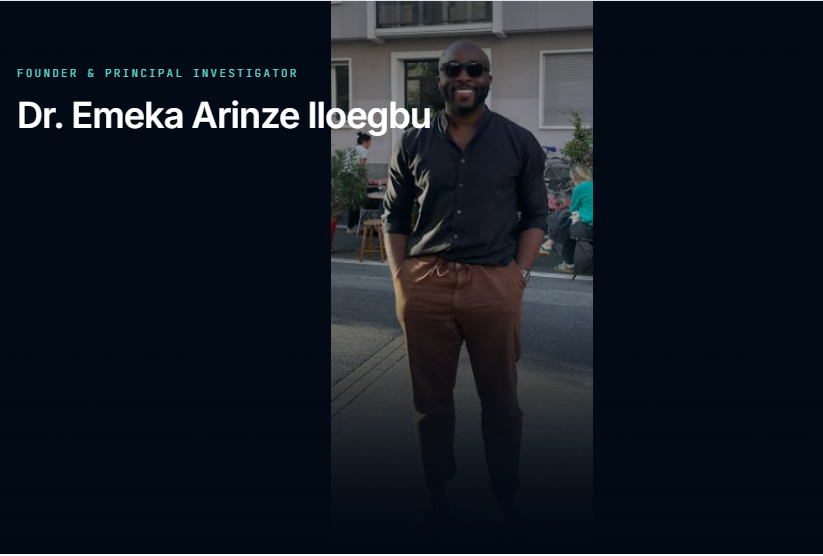
Dr. Emeka Arinze Iloegbu is a field laboratory epidemiologist, operational researcher, biosecurity specialist, and global health leader. He maintains active licensure and certification as a Clinical Laboratory Scientist specializing in diagnostic microbiology and hematology. His career spans more than fifteen years across clinical medicine, public health, academia, international organizations, government, and frontline field operations.
Academically trained at New York University, the Columbia University Mailman School of Public Health, the Icahn School of Medicine at Mount Sinai, and the University of Hartford, he works at the intersection of laboratory science, epidemiology, health systems, epidemic intelligence, and global health policy. His professional experience spans leading academic medical centers and public health laboratory settings in New York City, and he currently holds faculty appointments at the City University of New York and the New York University School of Global Public Health.
He serves as the New York United Nations Focal Point for the World Federation of Public Health Associations and leads scientific work within its Global Health Policy Task Force. His field and research activities span the United States, sub-Saharan Africa, and other international settings, integrating laboratory systems, disease surveillance, multimodal field investigation, and operational research.
Across these experiences he has developed a distinctive focus: transforming fragmented scientific, laboratory, field, and contextual information into intelligence that can guide action before, during, and after public health emergencies. That focus is the foundation of Emarin and of Applied Epidemic Intelligence as an interdisciplinary approach.
Why Emarin was founded
Throughout his career, Dr. Iloegbu observed the same challenge repeatedly. Global surveillance systems have become exceptionally effective at detecting and verifying outbreaks. Yet after an alert is issued, governments and organizations are still left asking critical operational questions:
- What should we do first?
- Where should resources be deployed?
- Which communities require immediate attention?
- How should laboratories prepare?
- Which intervention will have the greatest impact?
Emarin was founded to bridge that gap. Rather than producing another surveillance platform, Emarin transforms verified epidemic intelligence into operational intelligence utilizing a Multi-modal Field Epidemic Intelligence method, helping organizations prioritize action, strengthen local response capacity, and make evidence-informed decisions faster.
A different perspective
Unlike many organizations working solely in epidemiology, modeling, or consulting, Dr. Iloegbu's approach has been shaped by firsthand experience across every level of the health system. He has worked in hospital laboratories diagnosing patients, public health laboratories responding to emergencies, international policy discussions at the United Nations, operational research, university classrooms training future health professionals, and field investigations supporting frontline facilities in resource constrained settings.
This unique combination allows him to connect global strategy with local implementation, ensuring that recommendations are both scientifically rigorous and operationally practical.
Building the future of epidemic intelligence
Today, Dr. Iloegbu leads Emarin's vision of creating a next generation epidemic intelligence and operational response organization. His long term vision is to combine agent based modeling, compartmental modeling with mobility covariates, uncertainty quantification, multi-modal data integration, laboratory science, community based intelligence, field epidemiology, and operational research into a unified platform.
That platform must also contend with the modern information environment, where misinformation spreads faster than pathogens and can undermine an otherwise sound response.
The goal is to enable governments, health systems, humanitarian organizations, and private sector partners to move beyond simply understanding outbreaks toward making faster, smarter, and more effective operational decisions.
"Information alone does not save lives. Decisions do. The future of epidemic intelligence is not producing more reports, it is helping people know what to do next."
Dr. Emeka Arinze Iloegbu